Billing Automation Software: Rules vs. Ambient AI
A comparison of rules-based billing automation and ambient AI, with guidance on where deterministic workflows work best and where unstructured context requires more flexible interpretation.
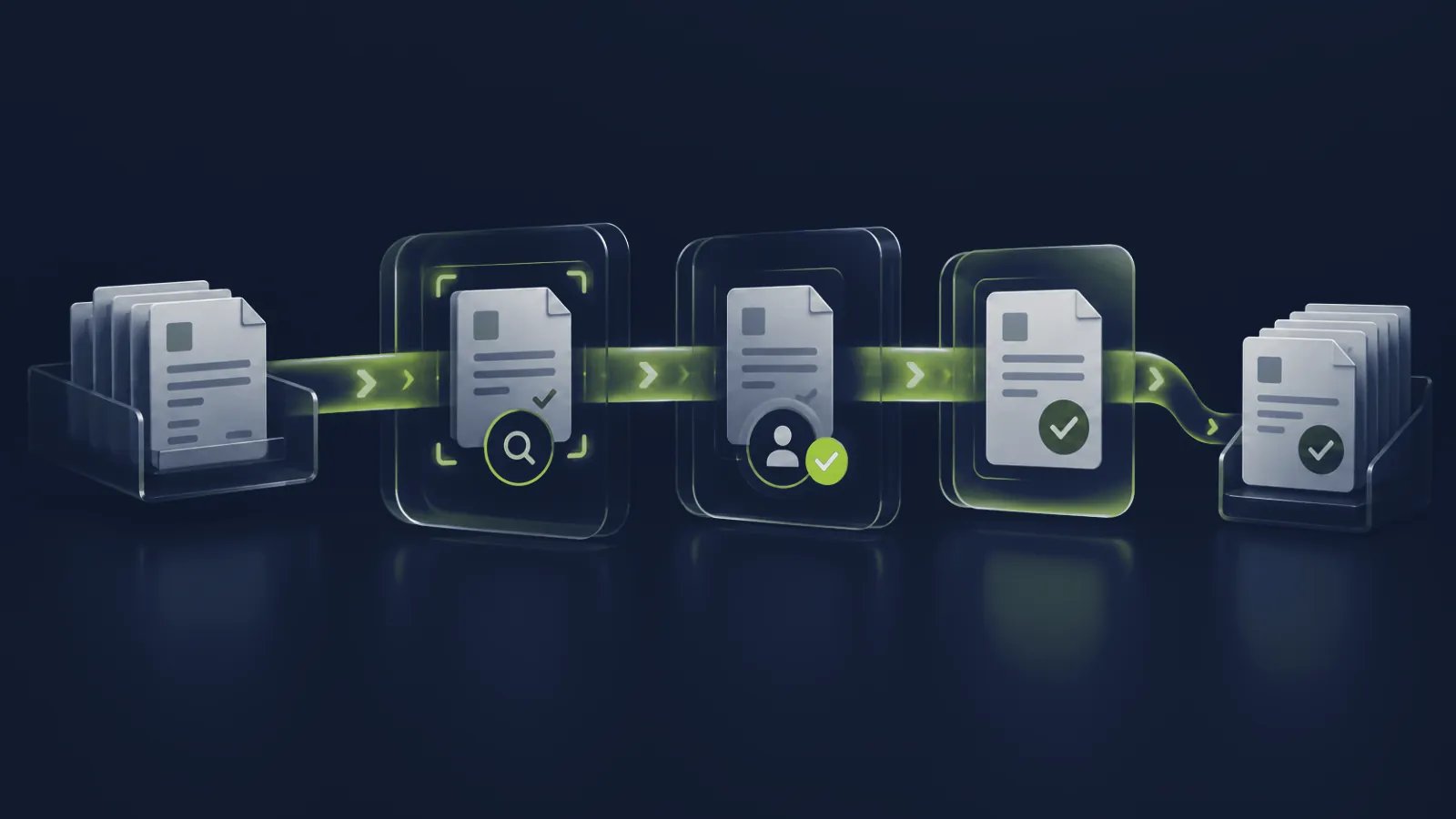
Billing automation software has traditionally worked best when the rules are explicit: charge a customer a defined amount on a defined billing cycle, generate a recurring invoice, collect payment through a payment gateway, and post the result to the general ledger.
Transportation billing is less tidy. Contracts change, accessorials arise during operations, customer instructions arrive by email, and valid exceptions do not always fit a fixed decision tree. That creates an important design choice: which billing workflows should remain deterministic, and where can ambient AI help interpret context that rules-based systems miss?
In practice, the two approaches complement each other.
What Is Billing Automation Software?
Billing automation software reduces the manual work required to create, validate, deliver, and track invoices.
Common capabilities span invoicing software, financial management, and payment workflows. They include:
- Automated invoice generation.
- Approval workflows.
- Recurring billing.
- E-invoicing.
- Payment processing to collect payments.
- Payment tracking.
- Dunning.
- Customer portal access.
- Accounting software and ERP integration.
- Revenue recognition support.
Automated billing software is common in software-as-a-service and subscription billing because recurring invoices, MRR, ARR, monetization rules, and standard pricing models can often be represented explicitly.
Freight billing includes many of those financial operations but adds more transaction-specific context.
How Rules-Based Billing Automation Works
A rules-based automated billing system follows predefined logic.
For example:
- If a subscription renews on the first day of the month, create the recurring invoice.
- If payment is overdue by 10 days, trigger dunning.
- If a shipment meets a defined accessorial condition, add the contracted fee.
- If an invoice exceeds a threshold, send it through an approval workflow.
This approach is predictable and auditable. The same input should produce the same output.
Rules are ideal when the commercial condition is stable, structured, and unambiguous.
Where Rules-Based Workflows Break Down
The weakness appears when the relevant information is not represented in structured fields.
A transportation agreement may say one thing, an email may approve a temporary exception, and an operations note may document a customer-requested change. A billing platform that only sees the TMS fields may apply the standard rule even though the commercial reality changed.
Rules-based automation can also become difficult to maintain when pricing models contain many customer-specific exceptions. Each new edge case creates another branch in the workflow.
Deterministic rules can still fail when the system lacks the facts required to choose the correct rule.
What “Ambient AI” Means in Billing
Ambient AI can observe and interpret information that already exists across normal business activity: contracts, communications, documents, and system events.
In billing, that can mean using AI to identify a new agreement term, recognize an approval in email, connect a service exception to a load, or surface a mismatch between the expected and actual charge.
The AI is not necessarily the billing system of record. It can act as a context layer that helps existing accounting systems, CRM, and ERP workflows make better decisions.
Use Rules for Deterministic Calculations
Fixed rules should remain the default for calculations that are already well defined.
Examples include:
- Standard recurring billing cycles.
- Tax logic already handled by the accounting platform.
- Contracted rates with unambiguous inputs.
- Approved payment processing rules.
- Revenue recognition schedules handled by established financial systems.
- General ledger mappings.
There is little value in asking a probabilistic model to recalculate a formula the system can execute exactly.
Use AI to Find the Context the Rule Engine Is Missing
AI becomes useful when the question is interpretive rather than arithmetic.
Examples include:
- Which contract version applies?
- Did the customer approve this exception?
- Does an email change the standard pricing model for this shipment?
- Is there evidence supporting an accessorial?
- Does a document contain a rate that conflicts with the ERP?
- Is a draft invoice inconsistent with the operational record?
The AI can surface the evidence, while the billing workflow applies the deterministic calculation after the relevant facts are established.
The Hybrid Model: AI Plus Billing Controls
A useful architecture separates observation from financial execution.
Ambient AI can monitor unstructured context. Rules can calculate known amounts. Approval workflows can handle ambiguity. Accounting systems can remain the financial system of record.
A hybrid flow might look like this:
- AI identifies a possible billing exception from a contract or email.
- The system links it to the relevant transaction.
- A rules engine calculates the expected charge.
- The platform compares the expected result with the draft invoice.
- A human reviews only the ambiguous case.
- The approved result posts to the ERP or accounting system.
That design keeps automation explainable.
Billing Automation and Cash Flow
The value of automation is not simply fewer keystrokes. Billing quality affects cash flow and DSO.
An automated billing platform can create invoices faster, but inaccurate invoices create disputes and delayed payment. The more important KPI is therefore accurate time-to-invoice: how quickly the company can produce a correct, supported invoice.
That is also where revenue leakage appears. If automation speeds up invoice creation while continuing to miss billable services, the process becomes faster without becoming financially better.
Integrations to Evaluate
Billing automation software should fit the systems already used by finance and operations.
Evaluate connectivity with:
- ERP platforms.
- CRM systems.
- Accounting systems.
- Payment gateways.
- Accounts payable and accounts receivable workflows.
- Customer portal tools.
- QuickBooks or other accounting software where relevant.
- Operational systems that hold the transaction data.
The integration should support both data flow and auditability. A corrected billing decision needs to reach the system of record without losing the reason for the change.
Controls for AI-Enabled Billing
AI changes the review model, but it should not eliminate financial controls.
AI-enabled billing needs governance, measurement, transparency, and ongoing risk management. Practical controls include:
- Source evidence for AI-derived facts.
- Confidence thresholds.
- Role-based approvals.
- Audit trail retention.
- Testing against known historical cases.
- Monitoring for changing error patterns.
- Clear limits on what AI can post automatically.
The higher the financial impact, the stronger the control should be.
Rules-Based vs. Ambient AI: Which Should You Choose?
Choose rules when the input is structured and the outcome should be deterministic. Use AI when the system needs to interpret documents, communications, or changing context before the rule can be applied.
For subscription billing, recurring revenue, and stable billing cycles, rules may handle most of the workflow. For complex transportation billing, ambient AI can add value because critical facts are often fragmented across systems and unstructured data.
The billing process needs access to information that traditional automation cannot see; that does not require replacing a proven automated billing system with a chatbot.
Build Automation Around the Evidence
A good billing automation architecture can explain every important result.
Groundtruth is designed around that principle for transportation. It connects agreements, communications, exceptions, and operational systems so potential billing errors can be surfaced before invoices are sent.
Rules remain valuable. AI expands what the rules can see. Used together, they create a billing process that is both scalable and grounded in the underlying commercial evidence.